When the Wizard’s only advice is to “Go out, get laid, get drunk, cause we’re all fucked anyway,” that’s when we know for sure we aren’t in Kansas anymore.
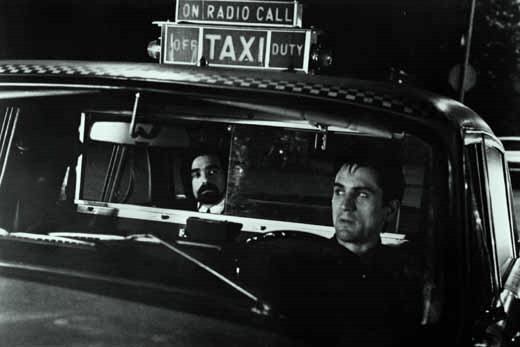
Taxi Driver is a Martin Scorsese film where a despicable character becomes the hero. The film is set in the streets of urban New York. The screenwriter, Paul Schrader, says he used New York because the city represents everything forbidden and crazy, but the irony is that it is the loneliness place. “You can only do real true loneliness in a crowded atmosphere,” Schrader explains. And Taxi Driver is a story about male drifting loneliness or more specifically self-imposed loneliness.
Travis Bickle (Robert DeNiro) is the confused protagonist in search for his identity and place in this world he considers hell. He’s referred to as the doughboy who will do anything for a dollar. Travis is a taxi driver who spends most nights alone, driving around in the darkness in search of an identity. However, he has a syndrome of behavior that reinforces contradictory impulses. The viewer witnesses this as the film progresses; Travis engages in porn and puritism at the same time and often says “I gotta get healthy,” but then proceeds to ingest numerous, unidentified pills. Travis does all these things to make sure he’ll never get where he’s going. He reinforces his own doomed condition by preventing himself from achieving his goals.

Cause-effect logic and narrative parallelism generate a narrative, which projects its action through psychologically defined, and goal-oriented characters, however, Travis is a character who does not operate in a parallel pattern. Cause and effect events in Taxi Driver are limited as the narrative is much more intransitive and loose. The world Travis lives in is chaotic and absurd at night, but seemingly harmless during the daylight hours. The government is frequently spoken of, but unfortunately not in control. The streets are dangerous, dirty, and full of crime. Palantine is the last name of the man running for office, but it is not coincidental that the names literal meaning is an old culture that has been destroyed. The world presented in Taxi Driver is not to be desired. Travis describes everyone around him as “cold and distance like the union, especially the women.” Lots of red color and red lighting is used in the film and can be seen in nearly every shot. At one point in the film, Travis tells Betsy (Cybell Shepherd), “You’re in hell and you’re going to die in hell like the rest of them!” This quote may be explaining the excessive use of red coloring in the film, as the color red has been closely associated with hell.
Cinematic representation, mise-en-scene, cinematography, and sound are devices in which specifically function in a way that ultimately advances the narrative. Taxi Driver uses these things and formal experimentation to not only keep the film advancing, but also to raise questions and give freedom to thought. This film allows its audience to decide for themselves what it is they are seeing and its meaning.

Many American values and traditions are challenged in Taxi Driver. Prostitution and rape is presented as a way of everyday life. Iris (Jodie Foster) is only twelve years old, but the only one questioning the morality of the situation is Travis. He sees Iris as a classic flower in a dirty place much like her name implies. He sees her trying to get away and escape from this world and he identifies with that need to escape. Innocence often clashes with sin. Sexuality and age appropriateness is brought into question not only with Iris, but also when a young black boy tries to pay a whore to sleep with him.
Travis is very neutral about everything -politics, music, porn, and film. He didn’t know seeing a porn film was wrong until Betsy will no longer see him because he took her to see Sometime Sweet Susan. He distances himself from politics and avoids choosing a side. The film doesn’t even mention what party candidate Palantine is. Obsession is also brought into question when Travis refuses to leave Betsy alone. He never questions whether his actions are right or wrong, he just goes about life without direction of any kind. Classical perceptions of good and evil are both challenged and destroyed.
Racism is called into question in numerous scenes. The man in the backseat of Travis’ cab, explains that his wife is cheating on him with a “nigger” and Travis has just driven him to the location where he will commit murder as his wife has committed adultery. Racism toward white men is also seen when Travis finds himself in the wrong part of town and African Americans egg his car. Travis shows signs of latent racism when he stares at African Americans, but like most things he doesn’t pick sides. Women in this film are disrespected and seen only for sexual pleasure, often being referred to as nothing other than pussy. Homosexuality is mentioned briefly in the coffee shop, but portrayed in a negative light when Wizard (Peter Boyle) talks about two men being fags. The pursuit of happiness is only mentioned as being something of the past.

Depressed Travis confronts his old and wise friend, Wizard. Travis tells Wizard he has bad thoughts and doesn’t know what to do. He is worried and conflicted unsure of what’s right and wrong. At this point, Travis is on the verge of going psychotic. Wizard’s only advice is to “go out, get laid, and get drunk, cause we’re all fucked anyway.” Travis hates the “Taxi Life” of others but can’t sleep because of his sexual frustration.
The characters of the classical narrative have clear-cut traits and objectives, but Travis’ character is more like those found in art cinema –characters that lack defined desires and goals and who’s choices are vague or nonexistent. Travis is similar to an art-film character, sliding passively from one situation to another. He says, “One of these days I’m going to get organized,” but instead he slips into a psychotic state after being fed up with the disgusting world he lives in. “Bars, cars, sidewalks, stores everywhere there’s no escape,” Travis quotes Thomas Wolfe, “I’m God’s lonely man.”
Travis decides to take action and prepare for war. He buys an entire case of guns from a traveling salesman and begins his training. He begins thinking he is the only solution this world has because, “All the kings men cannot put it back together again.” He takes on another identity when the secret service man asks for his name and address. He’s loosing control and easily breaks his television. He then writes home to his parents, telling them he’s part of the secret service and in a relationship with Betsy. If it’s not already obvious he’s lost his mind he goes on talking to himself, “Listen you fuckers, you screw heads. Here’s a man who would not take it anymore, a man who stood up against the scum, the cunts, the dogs, the filth, the shit. Here is someone who stood up. Here is… your dead.”

Travis’ insanity comes in handy when a stick-up occurs in the store he is present in. Travis shoots the black man right in the face. He could have just injured him, but killed him instead. Was it because the thief was black that Travis shot him or did his latent racism have nothing to do with the justice he was serving? The film raises many questions to the audience and never clearly picks a side. Travis tries to help Iris and tells her to go back home, but she refuses. He is trying to cleanup this world he lives in. He tells Iris he wants to give her the money to go to the commune, because he’s got nothing better to do with his money. Iris wants him to come along, but he has assassination plans that are not real clear.
Travis thinks he has to do this for the government, and that he is finally seeing life clearly. He says he never had a choice, but only that this was his destiny. His Mohawk symbolizes his mental deterioration and insanity. However, he surprisingly hesitates and doesn’t kill Charles Palantine. Instead, Travis rushes off to where Iris is kept. He kills Iris’ pimp, Mathew (Harvey Keitel), and continues this glorified bloodshed till he finds Iris. Travis tries to kill himself, but there are no bullets left. As the cops arrive, it appears that Travis takes his last breath and his eyes roll to the back of his head.
The overhead angle of the bloodshed is reflexive as it points out that it is a film. Overhead angles like this one is unnatural to the human eye and calls attention to the film’s aesthetics. The point of view is almost always from Travis’s view, but it is very distant because the point of modernist films was distancing. Distancing the audience from the characters helped to foreground issues. Giving the audience that distance from the character allows them to emotionally identify with whomever they want and see all viewpoints instead of choosing a side and being close-minded.
At one point, the point of view switches completely to that of Betsy’s POV. Travis is looking in his rear view mirror back at Betsy, and suddenly the camera moves to the backseat taking Betsy’s position and looking at Travis in the mirror. This shot may suggest that perhaps it is now Betsy that has a small obsession with Travis after reading about his heroism in all the newspapers. The camera often moves in other directions rather than following Travis. Sometimes Travis went one way and the camera went another way like when he’s talking on the phone and the camera moves pass him and focuses down an empty hallway. Scorsese chose to experiment with the mise-en-scene and editing as he used a lot of slow motion shots to represent a documentary of Travis’ mind. When the audience sees this slow motion they realize this is happening in the character’s mind. The last montage of city shots over lapping each other also points out once again that what the audience is experiencing is in fact a film. This style requires the audience to be observant and watch the film aggressively; otherwise the material may appear quite confusing.

Overall, the narrative was very structured, but the events of the story appeared free and loose at the same time. Contradictions were in every scene. Social and moral values were questioned through the formal aspects of cinema. Many other outside texts were referenced including Thomas Wolfe’ s “God’s Lonely Man,” Kris Kristofferson “The Pilgrim, Chapter 33,” Goodwin’s “Return to Greatness.” One of the best hidden references was the “Olive it Up,” advertisement that was written on the bus behind them when they were in the coffee shop. The viewer did not have to go outside of the film to understand the film, but knowing the outside references mentioned did help in clarification.
The film has an ambiguous ending as most modernist films. It’s a happy ending if the audience believes Iris is happy back in Pittsburgh as her family suggests. Perhaps this horrible experience successfully changed her ways as Travis had hoped. Maybe the cops really have been inspired by Travis’ actions against the gangsters and will now take control of the city. Even Travis’ love life looks promising when Betsy slides in Travis’ cab for a ride home. Travis’ psychotic fantasy did end in glorified bloodshed, but perhaps he didn’t wake up from that coma and his ride home with Betsy was simply taking place in his dreamlike state. Maybe Iris will return to the streets and prostitution. To some extent, the audience can choose their own ending, but the final shot of the film is without ambiguity as Travis finally takes Betsy’s advice and looks himself in the eyes through his rearview mirror -finally seeing the real, the truth, himself.
 1. Purple Rose of Cairo
 17. Blade Runner
 35. La Confidential
 52. Baby Driver
 69. Die Hard
 87. My Girl